Streamlined Council Approvals
Clear, standards-compliant documentation reduces planning delays and requests for further information from council officers.
Comprehensive, legally robust tree reports prepared by qualified AQF Level 5 consulting arborists.
Delivering consulting arborist reports across Kennington and the Bendigo region.
When property development, risk management, or council regulations require formal documentation, an arborist report Kennington clients rely on delivers clear, professional guidance.
Kennington’s mix of heritage-listed exotics and native box-ironbark vegetation requires precise identification and species-specific assessment to satisfy local planning guidelines.
Clear, standards-compliant documentation reduces planning delays and requests for further information from council officers.
Know the health, structural life expectancy, and retention value of your trees before investing in building plans.
Documented risk assessments demonstrate duty of care and protect you against liability disputes.
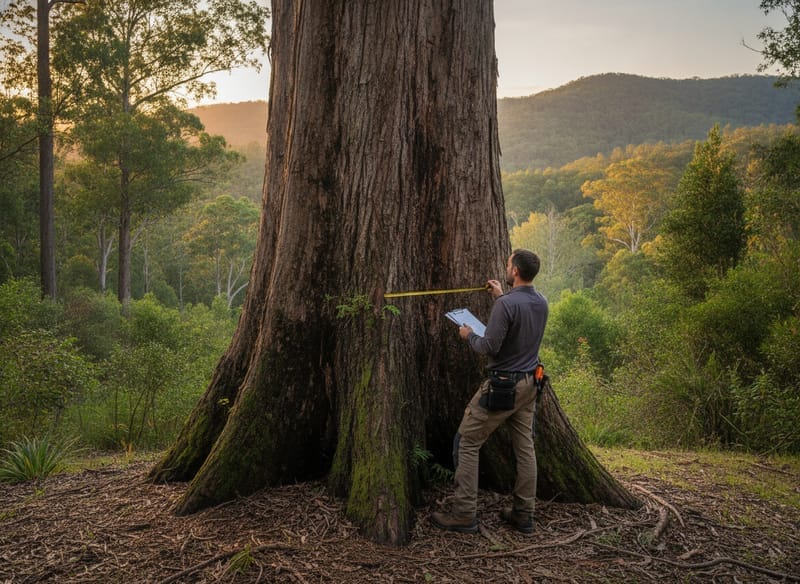
An AQF Level 5 arborist inspects each tree, recording species, dimensions (DBH), health, structure, and defects.
We calculate TPZ/SRZ offsets and cross-reference architectural drawings or planning overlays.
We write a structured, comprehensive report containing impact analysis, risk matrices, and recommendations.
You receive a complete digital report ready for submission to the City of Greater Bendigo or building certifiers.
Whether you are planning a new build on a bushy acreage, subdividing a suburban block, or managing a declining historic English Elm, securing a comprehensive Arborist Report Kennington is the crucial first step. Our local team provides the highly detailed, council-ready documentation required to move your property project forward without costly delays or regulatory hurdles.
Kennington and the wider Bendigo region feature a uniquely challenging mix of Victorian-era exotic street trees and remnant box ironbark forest. Managing vegetation in this environment requires a deep understanding of both the harsh, dry local climate and the complex regulatory framework governing tree retention. Our consulting arborists deliver detailed, objective assessments that satisfy the City of Greater Bendigo's stringent planning scheme, ensuring builders, developers, and everyday property owners can proceed with complete confidence.
From early-stage design advice for new developments to hazard assessments on mature Red Ironbarks prone to sudden summer limb drop, our reports are grounded in hard data and local expertise. We take the guesswork out of tree protection and removal, giving you a clear, compliant pathway forward.
One of the most common and expensive mistakes property owners and developers make is submitting a town planning or development application with a tree assessment written by an under-qualified contractor. The City of Greater Bendigo will routinely reject reports that do not meet their strict criteria, abruptly pausing your project and forcing you to start the assessment process from scratch.
Without an AQF Level 5 consulting arborist detailing exact Structural Root Zones (SRZ) and Tree Protection Zones (TPZ) in strict accordance with Australian Standards, your planning permit simply will not progress. DIY assessments or brief letters from a standard tree lopping service hold no legal weight. Furthermore, a poor assessment might recommend retaining a heavy canopy tree that sits on Bendigo's notoriously shallow, stony sodic soils with a compromised root plate—posing a severe future hazard to your new dwelling.
Our team solves this by doing the job right the first time. We produce highly detailed, legally robust reports that clearly outline tree health, structural integrity, and Safe Useful Life Expectancy (SULE). By aligning our documentation perfectly with the local planning scheme and AS4970 guidelines, we actively prevent council knockbacks, saving you thousands of dollars in holding costs, redesign fees, and wasted time.
Our AQF Level 5 consulting arborists deliver a range of highly technical reports tailored to your specific site and project needs. Every document we produce is structured to meet rigorous Australian Standards and the specific requirements of the local council.
Comprehensive tree inventories detailing species identification, DBH (Diameter at Breast Height), canopy spread, and SULE ratings. We identify which trees can be safely retained and which require removal, directly supporting your council submissions for new builds, subdivisions, and extensions.
Vital for construction sites to ensure retained trees survive the build. We map out exact Tree Protection Zones (TPZ) and Structural Root Zones (SRZ), specifying protective fencing, root mapping procedures, ground protection mulch layers, and supervised work zones.
Utilising Visual Tree Assessment methodology, we document structural defects, decay, and potential target zones. This is critical for schools, property managers, and homeowners concerned about limb drop or failure in mature local species like Grey Box or historic elms.
When council approval is required to remove a protected canopy tree or significant native vegetation under an overlay, we provide the documented evidence of poor condition, unacceptable risk, or irreversible structural failure required to legally justify the removal.
Detailed damage assessments and causation analysis following severe weather events, such as Bendigo's destructive spring storms. We provide expert documentation for insurance claims, neighbour disputes, and duty-of-care compliance.
Delivering an accurate and actionable Arborist Report Kennington requires a methodical, site-specific approach. When you contact our team, we start with a detailed consultation to understand the exact purpose of the report—whether it is for a pre-purchase property inspection, a multi-lot subdivision, or a dispute over a hazardous boundary tree. Next, our AQF Level 5 consulting arborist conducts a comprehensive site visit. We perform a Visual Tree Assessment (VTA), accurately measure trunk circumference at 1.4m and DBH at 1.3m, assess the canopy spread, and evaluate the surrounding soil and terrain context. In Bendigo, this often means noting shallow regolith, evidence of historic mine shafts, or proximity to heritage features. If you are developing the site, we carefully plot the existing trees against your proposed architectural plans to calculate precise encroachment percentages into the critical root zones. Back at the office, we draft the formal PDF report. This comprehensive document includes photographic evidence, detailed site maps, risk matrices, and clear retention or removal recommendations in strict accordance with AS4970 and AS4373 standards. We also outline any necessary replanting offsets required by council. Finally, we deliver the completed report directly to you, fully prepared for immediate submission to the City of Greater Bendigo. We remain available to answer any technical questions the council planner or your builder may have during the review process.
Arboricultural consulting is a highly regulated field where accuracy is paramount. Our reports are authored exclusively by AQF Level 5 (Diploma of Arboriculture) qualified arborists, which is the mandatory benchmark required by local authorities for development applications and formal tree risk assessments.
We operate with comprehensive Professional Indemnity and Public Liability insurance, providing you with total financial peace of mind when relying on our technical advice. Every report we write strictly aligns with AS4970 for tree protection on development sites and AS4373 for the pruning of amenity trees. We never recommend unacceptable practices like tree topping or lopping, ensuring our guidance is always scientifically sound, legally robust, and focused on long-term safety.
Producing an accurate arborist report in this region requires deep local knowledge. Under the state-wide Clause 52.37 Canopy Trees, boundary trees over 5m tall with a trunk circumference over 0.5m now face specific permit requirements, even on residential blocks in Kennington.
In bush-adjacent suburbs, the Significant Landscape Overlay (SLO1) heavily restricts the removal of native vegetation, making our detailed reporting essential to justify any clearing for bushfire safety or development. Furthermore, Bendigo's Heritage Overlays uniquely list individual trees by exact street address. If your property features a historic English Elm or mature oak, highly specialised management plans are required.
Our assessments also account for Bendigo's demanding terrain. The local sodic duplex soils feature buckshot gravel and heavy sandstone fragments from just 150mm down. This severely limits root penetration, meaning large native species like Red Ironbark and Yellow Gum often rely on wide, shallow root plates. We also factor in the structural risks posed by the region's 300 capped Depression-era mine shafts, ensuring heavy plant access and root zone calculations are safe and accurate.
Once you have your completed report, the next step is submission to the City of Greater Bendigo along with your broader planning or development application. If your report specifies a Tree Protection Plan, you must install the required AS4970-compliant fencing and ground-protection mulch layers before any heavy machinery enters the site.
When council formally grants your permit, our highly skilled AQF Level 3 climbing arborists can step in to execute any approved pruning, deadwooding, or complex tree removal work exactly as outlined in the document. Reach out to our team once your permit is approved to book the physical tree work and ensure full compliance from the initial assessment through to site clearance.
Arborist report pricing in Kennington is based on the number of trees assessed, project scope, and the required report type.
We provide fixed-fee quotes for consulting arborist reports tailored to your specific project needs.
We provide consulting arborist reports across Kennington and surrounding Bendigo suburbs.
Speak with our AQF Level 5 consulting team today for authoritative tree assessments and planning reports.
Request an Arborist Report